
Free sanctions screening report for any maritime entity
Run an instant first-pass check against 300+ watchlists including OFAC, UN, EU, and UK OFSI. See your result immediately, then request the full report by email. No credit card required.
Run an instant sanctions check
Enter a vessel name, IMO number, or company name to get an immediate first-pass result.
- OFAC
- UN
- EU
- UK OFSI
- SECO
- +300 more
- Result in seconds
- Vessels & companies
- Full PDF by email
Free report limit reached. For unlimited screening of vessels and companies, explore Maritime Intelligence or contact our team.
Request your free maritime sanctions report
Confirm your details and we will email your full report within 1 working day.
Report for
What you will receive
What is included in your free sanctions screening report
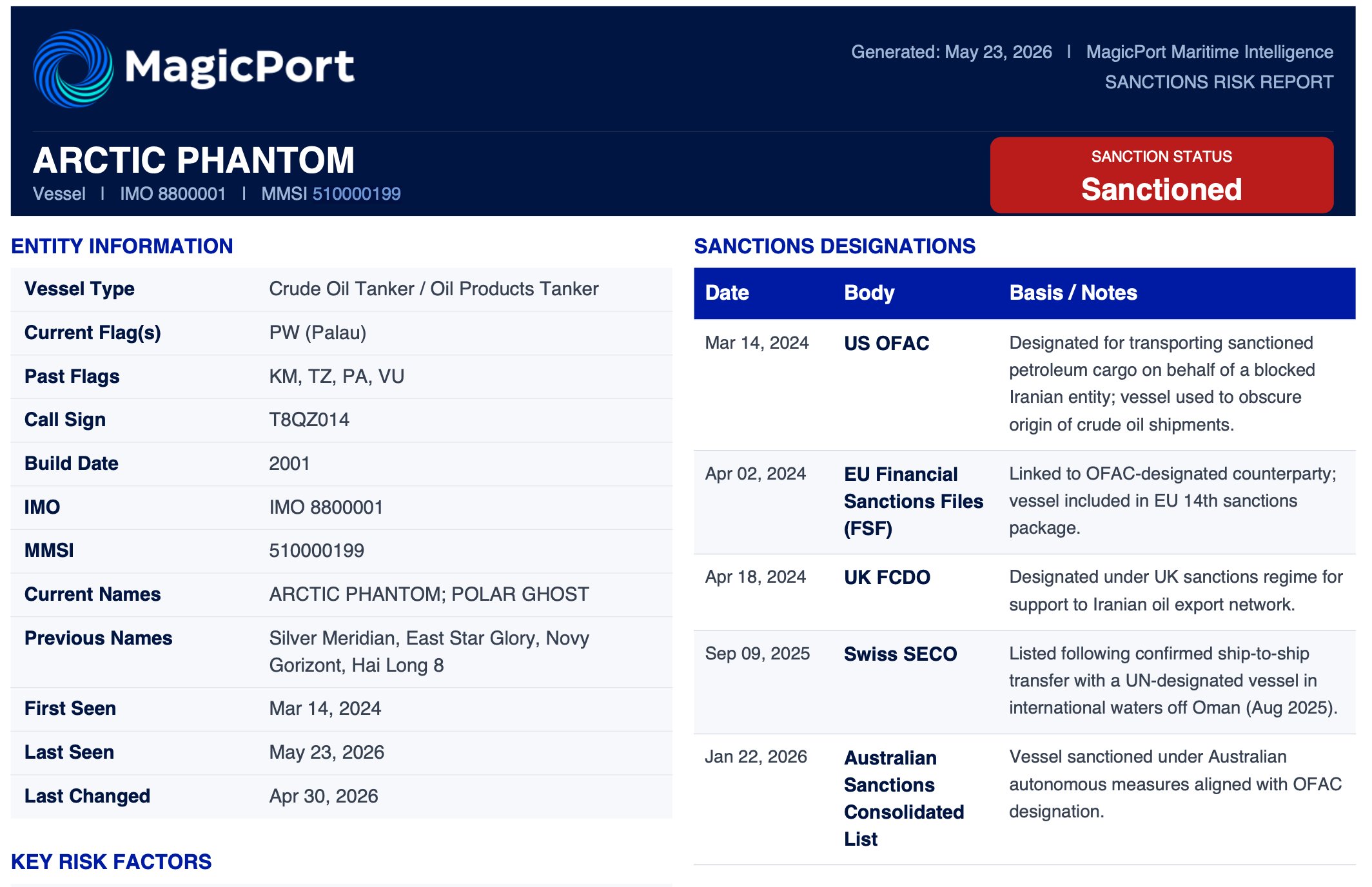
Your report includes sanctions status, watchlist hits, entity information, risk factors, and recommendations. All delivered in a professional, actionable format.
How it works
How vessel sanctions screening works in three steps
Run an instant check
Enter an IMO number, vessel name, or company name. See an immediate Sanctions Risks Found or No Matches Found result, with no account or credit card needed.
We screen watchlists and risk factors
MagicPort checks your entity against OFAC, UN, EU sanctions lists and 300+ other global watchlists using continuous data feeds. We also flag risk indicators such as calls at high-risk ports.
Unlock your full report
Share your contact details once your instant result comes back, and receive the full report by email, with entity identifiers, a watchlist breakdown, and any risk factors.
What public sanctions watchlists cover, and what they do not
Most maritime sanctions exposure is decided by four sources: the United States Office of Foreign Assets Control (OFAC), the United Nations Security Council, the European Union, and the United Kingdom Office of Financial Sanctions Implementation (OFSI). They overlap, but they are not interchangeable. A vessel or company designated by one authority may be absent from the lists of another, and the obligation that attaches to you depends on your nexus: your incorporation, your currency of settlement, your insurers, your flag, and the nationality of the people giving the instruction.
Regime | What it covers in a maritime context | |
|---|---|---|
SDN List | Designated persons, companies, and, increasingly, named vessels identified by IMO number. Blocking applies to US persons and to transactions touching the US financial system. Secondary sanctions risk can reach non-US parties. | |
Consolidated List | Designations agreed at Security Council level, including vessel designations under the DPRK and Libya regimes. Member states are obliged to implement, but timing and scope of national implementation vary. | |
Consolidated Financial Sanctions List | Asset freezes and prohibitions binding on EU operators, plus port access bans and service prohibitions that apply to specific vessels and trades. | |
Consolidated List of Targets | Asset freezes binding on UK persons worldwide and on anyone in the UK, together with shipping-specific prohibitions administered alongside the Department for Transport. |
A further set of national and regional lists matters depending on where you trade and bank: Swiss SECO, Canadian designations, Australian sanctions, Japanese METI measures, and Singapore regulations issued by the Monetary Authority of Singapore. MagicPort screens against these and other government and international watchlists, more than 300 in total.
Ownership tests extend the lists beyond the names printed on them
The single most common screening error is treating a list as a closed set of names. It is not. Under OFAC's 50 Percent Rule, any entity owned 50 percent or more, directly or indirectly, in the aggregate, by one or more blocked persons is itself blocked, even though its name appears nowhere on the SDN List. The EU and the UK apply a comparable ownership test alongside a separate control test, which can capture an entity where a designated person exercises control without holding a majority stake.
For shipping, this matters more than in most sectors. Ownership is routinely layered through single-ship companies, holding structures in several jurisdictions, and management agreements that separate the registered owner from the party actually directing the vessel. A name-only check against four lists will not surface a subsidiary that is blocked by operation of the ownership rule.
Why screening a vessel is harder than screening a company
Corporate screening has a stable subject. Maritime screening does not. Almost every attribute a vessel presents to the market can be changed, and several of them change for entirely ordinary commercial reasons. Knowing which identifiers persist, and which do not, is the difference between a screen that means something and a screen that returns a comfortable blank.
The IMO number is the only identifier that survives
The seven-digit IMO ship identification number is assigned once and stays with the hull for its working life, through sale, renaming, and reflagging. Everything else moves. The name can change on a Tuesday. The flag can change with it. The Maritime Mobile Service Identity (MMSI) and the call sign are issued by the flag administration, so both are reassigned when the vessel changes registry. Screening on a vessel name alone is screening on the least durable thing about it.
The counterparty is rarely a single entity
A port call typically involves a registered owner, a commercial manager who fixes the vessel, a technical or ISM manager responsible for safety management, sometimes a bareboat charterer standing in the owner's shoes, a time charterer, and a beneficial owner behind all of them. Each of these is a separate legal person, and a designation can attach to any one of them without attaching to the others. Screening the vessel and stopping there leaves the commercial chain unexamined.
Designations can attach to the vessel, the entity, or both
OFAC has designated vessels directly, identifying them by IMO number as blocked property. It has also designated owners and managers while leaving the tonnage unlisted, and it has delisted vessels while the associated entity remained blocked. A useful screen therefore returns three answers, not one: the status of the hull, the status of the parties associated with it, and the date on which each was last updated.
Historical association does not disappear when the ownership changes
A vessel sold out of a sanctioned fleet carries a history that counterparties, insurers, and port state authorities will still find. Prior names, prior flags, prior owners, and prior port calls remain part of the risk picture even when the current registered owner is unremarkable. A screen that shows only today's position is describing a snapshot of a moving object.
Risk indicators a watchlist screen will not raise
In May 2020 the US Department of State, OFAC, and the US Coast Guard published a joint advisory setting out the deceptive practices used to evade maritime sanctions. The practices below are drawn from that guidance. None of them produces a watchlist hit. All of them are visible in vessel movement and documentary data before a designation is ever made.
- 01
Disabling or manipulating AIS
Automatic Identification System transponders are switched off, or position data is spoofed, to conceal a call at a sanctioned port or a transfer at sea. Gaps that do not correspond to a known coverage problem are worth explaining.
- 02
Ship-to-ship transfers at sea
Cargo is moved between vessels outside a port to break the documentary chain between origin and delivery. Transfers in recognized transfer areas, at night, or with one party dark, warrant a closer look.
- 03
Falsified cargo and vessel documents
Bills of lading, certificates of origin, and inspection reports are altered to disguise the source of a cargo. Inconsistencies between documents, declared voyage, and observed track are the tell.
- 04
False flags and flag hopping
A vessel claims a registry it does not hold, or moves between registries repeatedly in a short period. Frequent reflagging without a matching commercial event is a documented evasion pattern.
- 05
Altered vessel identification
Physically painting over or changing an IMO number is rare but documented in the advisory. More commonly, a vessel is presented under a name that no longer matches the registry entry for that hull.
- 06
Voyage irregularities
Routes that make no commercial sense, unexplained deviations, loitering outside territorial waters, and draft readings inconsistent with a declared ballast or laden condition.
- 07
Complex ownership and management
Newly incorporated single-ship companies, registered addresses shared across unrelated fleets, and management changes immediately before a fixture. None of this is unlawful, and all of it raises the evidentiary burden.
A watchlist screen answers the question "has this entity been designated". It does not answer "is this entity behaving like one that will be". Those are different questions, and only the first can be answered from a list.
When to run a screen
Screening at account opening and never again is the most common gap in maritime compliance programs. Designations are made continuously, and the commercial chain around a vessel changes between one voyage and the next. The practical rule is to screen at the point of commitment, not at the point of introduction.
Ship agents
Screen at nomination, before the appointment is accepted, and again if the commercial manager or charterer changes mid-call. Screen the party you will invoice, not only the vessel, because the payment leg is where the exposure usually sits. Keep the timestamped result with the port call file alongside the port call record.
Owners, managers, and charterers
Screen before fixing, before nominating a sub-charterer, and before approving a bunker supplier or a ship-to-ship operation. Re-screen on option declaration for a period charter.
Suppliers, bunker traders, and service providers
Screen the vessel and the paying entity before stem confirmation and before delivery. A supplier delivering to a designated vessel has a problem regardless of who placed the order.
Finance, insurance, and brokers
Screen at the point of underwriting, at renewal, and whenever a change of ownership, management, or flag is notified. Prior names and prior flags belong in the file.
For ongoing monitoring rather than one-off checks, screening runs inside MagicPort Maritime Intelligence alongside vessel tracking and voyage data, so the screen and the movement history sit in the same place. You can also browse vessel and company records directly in the vessel directory and the owners and managers directory.
Common questions
Get answers to common questions about sanctions screening, report contents, and the screening process.
Frequently asked questions about maritime sanctions screening
What is a sanctions risk report?
A sanctions risk report is a screening document that checks a vessel, company, or individual against more than 300 government and international watchlists, including the OFAC Specially Designated Nationals list, the UN Security Council Consolidated List, the EU consolidated financial sanctions list, and the UK OFSI consolidated list. It records the identifiers screened, the result for each major regime, the designating body and date where there is a match, and related risk factors such as former names, former flags, and ownership changes.
How long does it take to receive my free sanctions report?
Your free sanctions risk report is delivered to your business email within 1 working day of submission. MagicPort screens the entity against more than 300 watchlists and compiles the result into a one-page report.
What information is included in the free sanctions report?
The report has five parts: entity identification showing the exact identifiers screened, such as IMO number, flag, MMSI, and former names; a headline screening status of either Sanctioned or No Matches Found; watchlist results broken down by regime, with the designating body and date for any match; risk factors such as former names, former flags, and ownership or management changes; and, for vessels, a factual port call history log.
Which sanctions lists does MagicPort screen against?
MagicPort screens against more than 300 watchlists. These include the US OFAC Specially Designated Nationals list, the UN Security Council Consolidated List, the EU consolidated financial sanctions list, the UK OFSI consolidated list of targets, Swiss SECO measures, Canadian designations, Australian sanctions, Japanese METI measures, Singapore regulations issued by the Monetary Authority of Singapore, and regional maritime watchlists.
Does a result of No Matches Found mean the vessel is safe to fix?
No. No Matches Found means that no match was returned on the watchlists screened at the time of screening. It is not a determination that a transaction is lawful, and it is not legal clearance. A public watchlist check cannot detect an entity captured by an ownership rule but not named on a list, and it cannot detect behavioral risk indicators such as AIS gaps or ship-to-ship transfers. Treat it as a first-pass check, then apply your own due diligence and, where the exposure warrants it, legal advice.
What is the OFAC 50 Percent Rule and how does it apply to shipping?
Under the OFAC 50 Percent Rule, any entity owned 50 percent or more, directly or indirectly, in the aggregate, by one or more blocked persons is itself blocked, even though its own name does not appear on the Specially Designated Nationals list. This matters in shipping because ownership is routinely layered through single-ship companies and holding structures across several jurisdictions, so a name-only check against the published lists will not surface a subsidiary blocked by operation of the rule. The EU and the UK apply a comparable ownership test alongside a separate control test.
Why is screening on a vessel name alone unreliable?
Because the name is the least durable identifier a vessel has. A vessel can be renamed and reflagged at any point, and the MMSI and call sign are reissued by the new flag administration when the registry changes. The seven-digit IMO number is assigned once and stays with the hull for its working life through sale, rename, and reflag, which makes it the reliable key for screening. Always screen on the IMO number where you have it.
Does MagicPort screen the owner and manager as well as the vessel?
Yes. A port call typically involves a registered owner, a commercial manager, a technical or ISM manager, sometimes a bareboat charterer, and a beneficial owner behind them, and a designation can attach to any one of these without attaching to the others. Screening the hull alone leaves the commercial chain unexamined, so the report surfaces the associated parties worth examining next alongside the vessel result.
How often should I re-screen a counterparty?
Screen at the point of commitment rather than only at the point of introduction, because designations are added and removed continuously and the commercial chain around a vessel changes between voyages. For ship agents that means at nomination and again if the commercial manager or charterer changes mid-call. For owners and charterers it means before fixing and on option declaration. For suppliers it means before stem confirmation and before delivery. For insurers and brokers it means at underwriting, at renewal, and on any notified change of ownership, management, or flag.
What should I do if my screen returns a possible match?
Do not treat a possible match as either confirmed or dismissed. Transliteration from Arabic, Farsi, Russian, and Chinese produces both false positives and false negatives, so the match needs adjudication against hard identifiers such as IMO number, company registration number, or date of birth. Verify the entry directly against the publishing authority, document the identifiers you compared and the date, and escalate to your compliance function or external counsel before proceeding with the transaction.
Is the sanctions screening report legally binding?
No. The report is provided for general guidance and due diligence purposes only. It does not constitute legal advice or a definitive compliance determination. Organizations should consult qualified maritime law specialists and compliance officers for final compliance decisions.
Can I screen both vessels and companies?
Yes. MagicPort screens maritime vessels using the IMO number or vessel name, and companies using the company name or registration details. The system also checks related entities so that the owner, manager, and other associated parties are visible alongside the vessel result.
How accurate is MagicPort's sanctions screening?
MagicPort uses continuous data feeds from official government sources to keep watchlists current, and cross-references vessel identifiers such as IMO number, MMSI, and call sign, along with company names and historical flag changes. No name-based screening system is free of false positives, particularly where names are transliterated from non-Latin scripts, which is why every possible match should be adjudicated against hard identifiers before a decision is made.
What happens after I submit the form?
After you submit the request you receive an immediate confirmation. MagicPort then screens the entity across more than 300 watchlists, compiles the result, and delivers the report to your email within 1 working day. A MagicPort specialist may follow up to walk you through the findings and answer questions. No commitment is required.
Run your first vessel sanctions check today
Used by 400+ shipping companies across 80+ countries to screen vessels and counterparties before every transaction.
This report is provided for general guidance only and does not constitute legal advice. Consult a qualified maritime law specialist for compliance decisions.