
Are your vessel data sitting in several different systems?
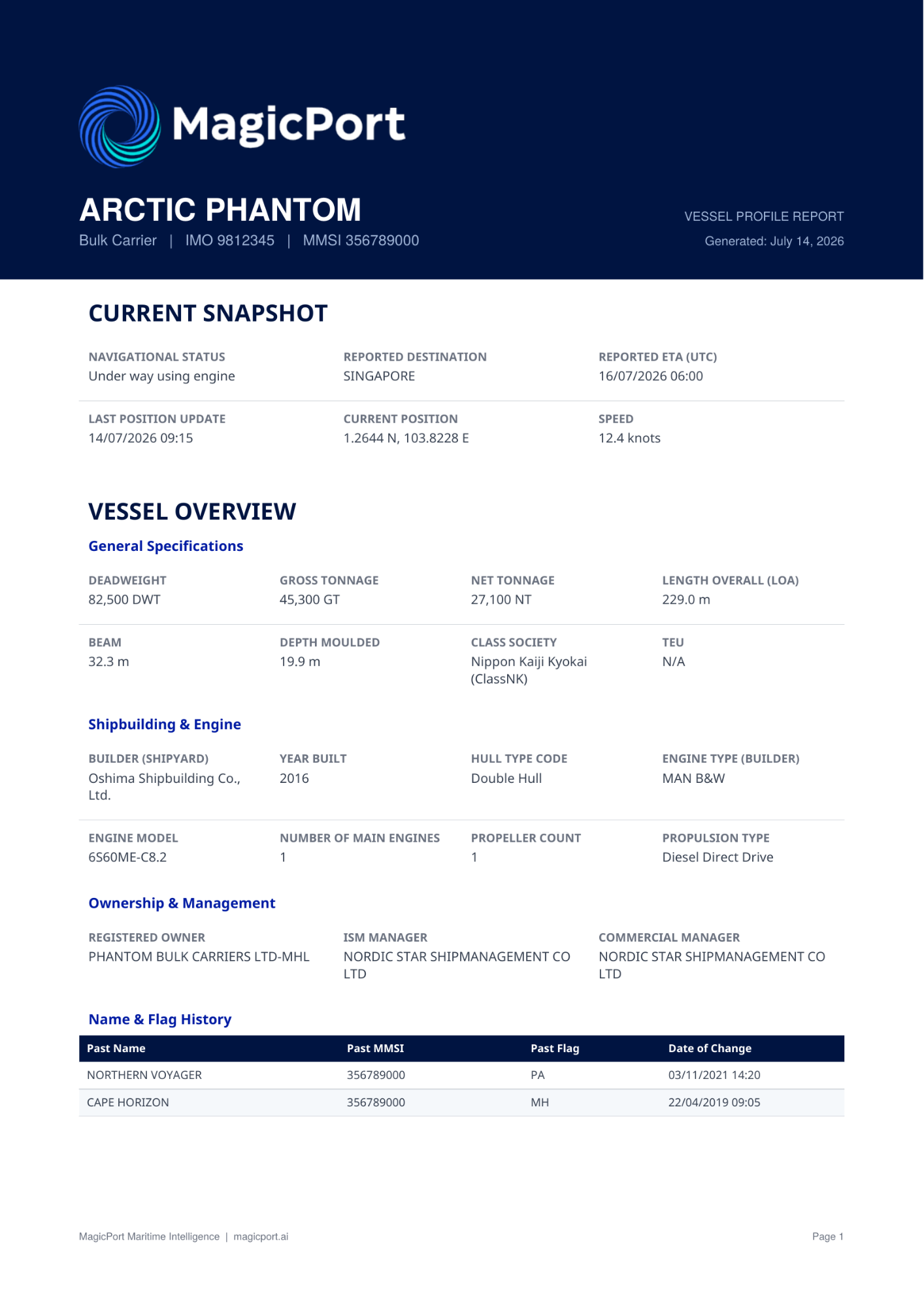
Enter a vessel name or IMO number and we will email a complete profile report: current navigational status and position, full specifications, ownership and management, port call history, class surveys, and certificate renewal dates.
The data exists. It is just never in one place when you need it
Verifying a vessel before a nomination, a port call, or a supply order usually means pulling from several places at once: an AIS provider for position, a class society or Equasis-style database for survey status, and the vessel's own paperwork for ownership and management. Each source is reliable on its own. None of them, alone, tells the whole story.
The gap shows up at the worst time. A vessel arrives with a class survey quietly overdue, or a supply order goes out before anyone notices the International Safety Management (ISM) manager changed hands last month. By the time the mismatch surfaces, the port call is already underway.
The free Vessel Profile Report pulls the current snapshot, specifications, ownership, port call history, class surveys, and certificate status into a single document, generated from the same live data behind MagicPort Maritime Intelligence.
What is in the report
Everything you would otherwise pull from separate systems
The free Vessel Profile Report reorganizes AIS data, class registries, and ownership records into a single, readable document.
Current snapshot
Navigation status, reported destination and ETA, last position update, and current speed.
Specifications and ownership
Deadweight, tonnage, dimensions, class society, builder details, registered owner, International Safety Management (ISM) manager, commercial manager, and past names or flags if the vessel has changed identity.
Port visits overview
A summary of ports called, ranked by visit count, with the most recent visit date for each.
Port call history
The most recent port calls in sequence, with departure and destination ports and arrival or departure timestamps.
Class surveys
Survey type, classification society, last survey date, and the next due date.
Certificates and renewals
Certificate type, issuing body, and issue and expiry dates, so renewal timing is never a surprise.
Built for the people who verify a vessel before committing to it
This report is written for ship agents preparing a port call, marine suppliers and service providers deciding whether to extend credit or accept a nomination, and owners' representatives who need a quick, reliable read on a vessel they do not operate.
Frequently asked questions
Frequently asked questions
What is a class survey, and how is it different from a statutory certificate?
A class survey is a scheduled inspection confirming a vessel remains compliant with its classification society's structural and mechanical standards. A statutory certificate instead confirms compliance with a specific regulatory requirement, such as pollution prevention or load line limits. A vessel can hold valid certificates while its survey is overdue, which can be a factor in port state control delays.
Why might a vessel's registered owner and ISM manager be different companies, and who should an agent or supplier invoice?
A registered owner holds legal title to a vessel, while the International Safety Management (ISM) manager is the entity responsible for operating it day to day, including authorizing port calls and approving supplies. Agents and suppliers typically deal with, and invoice, the ISM or commercial manager rather than the registered owner, since the manager is the operational point of contact.
What does an unusual port call pattern signal before accepting a nomination or supply order?
An unusual port call pattern, such as calls at ports outside a vessel's normal trade or unexplained extended stays, is worth a closer look before accepting a nomination or supply order. Combined with a vessel's name and flag history, it gives agents and suppliers a fuller picture of the vessel's recent operating pattern before committing resources.
Why do deadweight and gross tonnage matter differently when preparing a PDA or a supply order?
Deadweight tonnage indicates a vessel's cargo capacity and is the more relevant figure for suppliers estimating fuel, water, or provisions needs. Gross tonnage measures enclosed volume and is the basis most ports use to calculate port dues, pilotage, and other charges an agent must include in a proforma disbursement account.
What is the difference between an IMO number and an MMSI number, and which should an agent use to verify a vessel?
An International Maritime Organization (IMO) number is a permanent seven-digit identifier assigned once and never reissued, even after a sale, rename, or flag change. A Maritime Mobile Service Identity (MMSI) number identifies a vessel's radio and AIS transmission and can change when the vessel reflags. Agents verifying identity across a rename or flag change should rely on the IMO number, not the MMSI.
Why does a vessel's name and flag change history matter when reviewing a new nomination?
A vessel's name and flag change history shows how many times it has been sold, renamed, or reflagged, which can be a routine part of a normal trading life or a sign of an owner distancing a vessel from a troubled past. Reviewing this history alongside the current registered owner gives agents and suppliers a fuller picture before accepting a new nomination.
What is the difference between a port visits overview and a port call history?
A port visits overview ranks the ports a vessel has called at by frequency, showing the most recent visit to each, which reveals its regular trade pattern at a glance. A port call history instead lists individual voyages in chronological order, with departure and destination ports and timestamps for each. The two sections answer different questions: where a vessel usually goes, and what it did most recently.
How current is the navigational status and position shown in the free vessel profile report?
The navigational status, position, and speed in the free vessel profile report reflect the last AIS position update at the time the report was generated, typically within hours rather than days. For continuously updated tracking rather than a point-in-time snapshot, start a free trial for MagicPort Maritime Intelligence.
Get your free report
One vessel per request. We will email the report as a PDF.