
The 12 FDA line items principals dispute - and how to defend every one
Port charges can represent more than 20% of total vessel operating costs. When a principal pushes back on the Final Disbursement Account, the agent often carries the exposure - not the principal. This guide covers all 12 disputed line items, the dispute mechanism behind each, and the documentation that closes them.
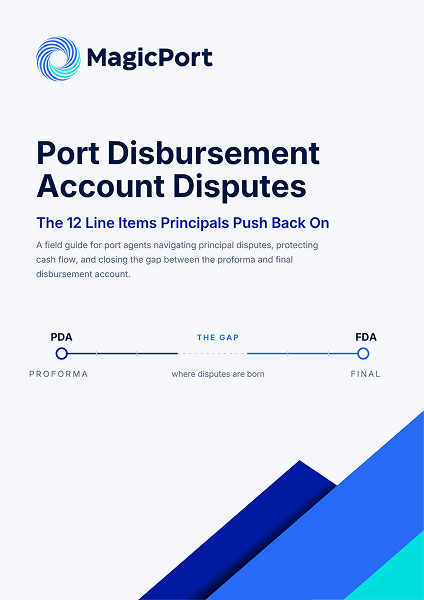
The gap between the PDA and the FDA is where disputes are born
Port disbursement accounting sits at an uncomfortable intersection: port agents are accountable for costs they often cannot fully control, while principals review invoices they did not witness being incurred. When the Final Disbursement Account (FDA) - the actual invoice submitted after a vessel departs - diverges from the Proforma Disbursement Account (PDA) the principal approved before arrival, they push back, line by line.
A query is a principal asking for clarification. A dispute is a principal refusing to release funds until a charge is revised or removed. The cash flow implications are different in kind, not just degree. Disputed FDAs can remain open for weeks, during which the agent may have already paid vendors and is carrying the exposure.
Understanding which line items are most likely to escalate from query to dispute - and preparing documentation before submission rather than after - is the most practical thing a port agent can do to protect the agency's financial position.
The three dispute mechanisms
Not all disputes are the same. The mechanism determines the defense.
The 12 line items in this guide are grouped by their primary dispute mechanism. Each type requires a different documentation response.
Rate disputes
The principal challenges the fee level or tariff rate applied to a charge. The agent may have charged the correct amount - but without a clear reference to the official tariff or appointment terms, the principal's position is that the rate is unsubstantiated.
Covers agency fees, overtime, and port dues.
Evidence disputes
The principal accepts that the charge exists - they know pilotage costs money, they know mooring gangs are necessary - but refuses to approve the FDA because the documentation supporting that charge is absent, incomplete, or inconsistent with other records such as the Statement of Facts.
Covers pilotage, towage, mooring, and waste disposal.
Authorization disputes
The charge was not in the PDA, or significantly exceeded the PDA estimate, and the principal's position is that the agent had no authority to commit that expenditure without prior written approval. These are the hardest disputes to win without documentation, because the agent's defense - "it was operationally necessary" - is a judgment call the principal did not get to make.
Covers launch hire, stevedoring extras, cash to master, crew expenses, and miscellaneous charges.
Dispute ranking by line item
The 12 most disputed FDA charges, ranked by frequency
Ranked by relative dispute frequency, based on MagicPort's assessment of documented industry patterns. Rankings reflect qualitative ordering, not empirical survey data.
| # | Line item | Dispute type | Most common trigger |
|---|---|---|---|
| 1 | Miscellaneous / Sundry charges | Rate & Evidence | Lack of individual invoices causes near-automatic rejection |
| 2 | Agency fees | Rate | Principals treat as negotiable post-PDA regardless of appointment |
| 3 | Cash to master | Missing signed receipt is the most common trigger | |
| 4 | Overtime / After-hours | Rate & Evidence | Necessity and correct tariff rate both challenged |
| 5 | Launch hire | Unscheduled trips disputed without master sign-off | |
| 6 | Cargo / Stevedoring extras | Verbal approvals not followed up in writing | |
| 7 | Port dues / Tonnage fees | Rate & Evidence | GT basis and tariff changes both challenged |
| 8 | Crew-related expenses | When authorization for services are not clear | |
| 9 | Pilotage | Evidence | Movement count mismatch with the Statement of Facts |
| 10 | Towage | Evidence | Mandatory vs. discretionary distinction not documented |
| 11 | Mooring / Unmooring | Evidence | SOF misalignment with gang shift invoices |
| 12 | Waste disposal | Evidence | Volume accuracy and environmental levy challenges |
Among the 300 most recent cases escalated to BIMCO's formal intervention service, successful collection was achieved in only 40% of cases. Disputes that are not resolved early become significantly harder to resolve at all.
Source: BIMCO Intervention Service, 2025
What the guide covers
A 17-page field guide organized by dispute type
Structured by dispute mechanism - not alphabetically, not by cost - because the mechanism driving a dispute determines the documentation that resolves it. Each line item stands alone: when a charge is queried, turn directly to that section for its documentation checklist.
Rate disputes
Agency fees, overtime and after-hours charges, port dues and tonnage fees. Why principals challenge the rate even when the tariff is published, and what evidence overrides the objection.
Evidence disputes
Pilotage, towage, mooring and unmooring, waste disposal, and miscellaneous charges. The charge is accepted in principle. The documentation is not. What a complete evidence package looks like for each line item.
Authorization disputes
Launch hire, cargo and stevedoring extras, cash to master, and crew-related expenses. These are the hardest disputes to win without documentation - because the agent's defense was a judgment call the principal did not get to make.
When a dispute is not resolved
The compounding cash flow impact of unresolved FDAs. When to escalate, when to negotiate, when to absorb. What repeat disputes by the same principal signal about the agency relationship.
Reducing dispute exposure before the FDA
An 18-checkpoint pre-submission checklist, organized by pre-arrival, during the port call, and post-departure stages. Work through it before sending any FDA. The most effective intervention point is before the FDA is sent, not after it is challenged.
Built for port agents who are already managing this problem
This guide is written for port agency operations teams, FDA reviewers, and agency principals who deal with disputed disbursement accounts on a recurring basis. It assumes you know what a PDA is. It does not explain basics. It goes directly to the line items that generate the most disputes and the documentation that resolves them.
Common questions
Frequently asked questions about FDA disputes
What is a port disbursement account dispute?
A port disbursement account dispute occurs when a principal refuses to release funds against a Final Disbursement Account (FDA) until a specific charge is revised or removed. Unlike a query - which is a request for clarification - a dispute withholds payment. Disputed FDAs can remain open for weeks, during which the agent may have already paid vendors and is carrying the financial exposure.
What is the difference between a PDA and an FDA?
A Proforma Disbursement Account (PDA) is the upfront cost estimate a port agent prepares before a vessel arrives, covering expected port charges, pilotage, towage, agency fees, and other services. The Final Disbursement Account (FDA) is the actual invoice submitted after the vessel departs, reflecting what was genuinely incurred. The gap between PDA and FDA - caused by tariff changes, additional services, or timing variances - is where most disputes originate.
What are the three types of FDA disputes?
FDA disputes fall into three categories: (1) Rate disputes - the principal challenges the fee level or tariff rate applied; the agent may have charged the correct amount, but without a clear reference to the official tariff, the rate is considered unsubstantiated. (2) Evidence disputes - the charge is accepted in principle, but the documentation supporting it is absent, incomplete, or inconsistent with other records such as the Statement of Facts. (3) Authorization disputes - the charge was not in the PDA, and the principal's position is that the agent had no authority to commit that expenditure without prior written approval.
Which FDA line items are most commonly disputed?
The most frequently disputed FDA line items are: (1) Miscellaneous and sundry charges - lack of individual invoices causes near-automatic rejection; (2) Agency fees - principals treat these as negotiable post-PDA; (3) Cash to master - a missing signed receipt is the most common trigger; (4) Overtime and after-hours charges - both necessity and the correct tariff rate are challenged; (5) Launch hire - unscheduled trips disputed without master sign-off. Rankings are based on MagicPort's assessment of documented industry patterns across FONASBA, BIMCO, and maritime industry sources.
What documentation resolves a cash to master dispute?
To resolve a cash to master (CTM) dispute, the agent needs: a signed master's receipt for the exact amount disbursed in the currency disbursed; the exchange rate applied, referenced to a verifiable source such as the bank rate at time of transaction; written authorization from the principal or ship management company for the CTM amount; and, if the CTM was the master's request, written or email confirmation of that request from the vessel. The receipt should be scanned the moment it is signed and attached to the port call record before the vessel departs.
What happens if an FDA dispute is not resolved?
Unresolved FDA disputes compound quickly for agencies handling multiple simultaneous vessel calls. According to BIMCO's intervention service data, of the 300 most recent cases escalated to formal intervention, successful collection was achieved in only 40% of cases. Disputes that are not resolved early become significantly harder to resolve at all.
How can port agents reduce FDA dispute exposure before submission?
The most effective intervention point is before the FDA is sent, not after it is challenged. Key steps include: confirming the appointment letter is signed with fee and scope in writing before arrival; logging every service as it happens rather than reconstructing records; scanning the cash to master receipt the moment it is signed; flagging any out-of-PDA costs to the principal in writing at the moment they are incurred; reconciling the Statement of Facts against every time-based charge before submission; and ensuring every FDA line item has its own named label with no grouped miscellaneous entries.
Why do principals dispute agency fees even when the appointment letter states the agreed amount?
Principals dispute agency fees because they treat them as negotiable post-PDA, often benchmarking the fee against competing agents in the same port even when there was no competitive tender. In time charter arrangements, charterers may argue that certain husbandry services fall outside the agreed scope. The most common agency fee failure is not a wrong rate - it is a vague appointment letter. A letter that states 'standard agency fee applies' without specifying what that fee covers gives the principal legitimate grounds to question every service line.
About MagicPort
The documentation gaps in this guide are the exact workflows MagicPort closes in real time
The documentation gaps in this report - missing launch logs, unattached vendor invoices, SOF misalignments, unauthorized scope charges - are the exact workflows MagicPort is built to close in real time, not retrospectively. Every service and charge is logged against the port call record as it is incurred. Every invoice is attached at the line level. Every PDA variance is flagged the moment it occurs.
One operational spine
Email threads, forwarded PDAs, and manual spreadsheets replaced by a single record all parties read from at once.
Logged in real time
Services, invoices, and approvals captured as they happen - not reconstructed from memory after the vessel sails.
FDA-ready on departure
Every line referenced, every variance flagged, so the principal's reviewer has nothing left to question.
300+ shipping companies across 40+ countries use MagicPort to improve their operations and customer service, and grow their business efficiently.
Download the full guide
We'll email the 17-page PDF and an 18-checkpoint pre-submission checklist directly to your inbox.